

What Items Can You Send from India to the UK? Allowed, Restricted & Prohibited Items (2026)
If you are checking what items you can send from India to the UK, many personal and business goods are eligible—but every parcel must pass Indian export rules, UK import rules and the selected courier’s transport policy. An item may be legal to export yet still require documents, special packaging or carrier approval.
For collection, pricing and delivery options, visit our India-to-UK courier service page.
Quick India-to-UK Item Checker
Use this table as a starting point. Always confirm your specific items with UDS before packing.
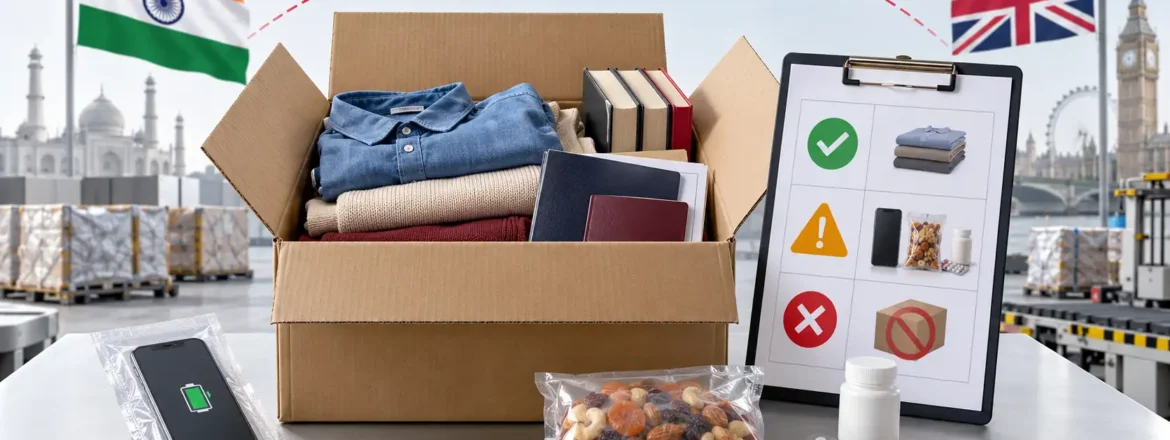
| Item | Usually Allowed | Restricted | Common Requirements |
| Clothes & personal belongings | ✔ Yes | Declare accurately with value | |
| Books & study materials | ✔ Yes | None for personal use | |
| Documents | ✔ Yes | Describe as ‘documents only’ | |
| Packaged food (sealed, non-perishable) | ✔ Yes | Original packaging, ingredient label | |
| Medicines | ⚠ Restricted | Prescription, invoice, import permit (if required) | |
| Electronics (phones, laptops) | ⚠ Restricted | Proof of purchase, accurate value declaration | |
| Lithium batteries (standalone) | ⚠ Restricted | Carrier approval required; often refused loose | |
| Jewellery | ⚠ Restricted | Declaration, proof of ownership, value | |
| Cosmetics & perfumes | ⚠ Restricted | Limited quantities; aerosols may be refused | |
| Personal effects (used) | ✔ Yes | Declared as personal effects, not for resale |
This checker provides general guidance and does not constitute booking approval. UDS must confirm the exact item, quantity, condition, packaging, liquid content and battery specifications before collection. Check India to UK courier charges per kg.
Note: “Usually allowed” means accepted under normal conditions for personal use. Acceptance is not guaranteed for every item in every quantity. Always confirm before booking.
Three Sets of Rules Every Parcel Must Pass
- India export restrictions – certain goods require an export licence or are prohibited from leaving India entirely. Indian customs checks outbound parcels and may hold or open shipments where items are not correctly declared.
- Airline and courier dangerous-goods rules – carriers operating air freight routes apply IATA dangerous-goods regulations independently of customs law. Items such as standalone lithium batteries, aerosols, flammable liquids, and certain cosmetics may be refused by the carrier even if legally exportable.
- UK customs and import restrictions – HMRC and the UK Border Force control what enters Great Britain. Import VAT and Customs Duty depend on the type and value of the consignment. Genuine gifts have separate relief rules: import VAT may apply when the gift value exceeds £39, while Customs Duty may apply above £135. Excise goods and certain other categories follow different rules.
A parcel that passes Indian export checks can still be refused by the carrier or held by UK customs. Check all three before packing.
Items Usually Accepted from India to the UK
- Clothes and personal belongings – clothing, footwear, and personal effects for personal use are widely accepted. Declare each item with an accurate description and honest value. Mark clearly as personal use, not for resale.
- Books and study materials – Books and printed study materials are generally accepted for personal use, subject to content restrictions and accurate declaration.
- Documents – legal documents, contracts, certificates, and official papers can be sent. Describe the parcel as ‘documents only’ on the declaration and do not include any commercial goods in the same box.
- Non-hazardous household items – non-electrical, non-liquid household goods in reasonable quantities for personal use are generally accepted.
- Gifts – commercially packaged gifts with accurate item descriptions and declared values. Marking a parcel as ‘gift’ does not exempt it from customs inspection or duty above the UK threshold.
- Eligible packaged foods – factory-sealed, non-perishable items such as spices, dry snacks, tea, coffee, and pulses may be accepted. GOV.UK separately regulates food and animal products entering Great Britain. Refer to official UK food import guidance at gov.uk before shipping food items. Check India to UK food guide.
Restricted Items Requiring Approval or Additional Documents
- Medicines and supplements – Medicine acceptance depends on the exact product, active ingredients, quantity, UK controls and carrier policy. Medicines containing controlled drugs should not be sent through an ordinary overseas postal or courier service. GOV.UK advises that controlled medicines should be imported through an appropriately registered pharmaceutical wholesaler. Confirm the exact medicine and available service with UDS before booking.
- Electronics and lithium batteries – mobile phones, laptops, and tablets are accepted with proof of purchase and accurate declared value. Devices must contain lithium batteries fitted inside, not loose. Standalone lithium batteries are subject to strict carrier rules and are frequently refused for air shipment.
- Food and animal-origin products – acceptance depends on specific ingredients, packaging, and UK import rules for the product category. See the dedicated India-to-UK food guide for full detail on what is and is not accepted.
- Plants, seeds, and agricultural products – Some plants, seeds and plant products require a phytosanitary certificate and advance import steps, depending on their risk category; others may be prohibited.
- Jewellery and high-value goods – High-value jewellery may be restricted by the courier or compensation policy and requires pre-approval, accurate valuation and supporting evidence.
- Commercial samples and business shipments – require a commercial invoice, packing list, and in some cases an export licence from India. VAT registration details may be needed for the UK recipient.
Items Prohibited or Commonly Refused
The following are either legally prohibited or routinely refused by carriers. Legal prohibition and carrier refusal are distinct: a carrier can refuse an item that is technically legal if it conflicts with their operating policy.
- Illegal and controlled drugs — prohibited under both Indian and UK law
- Weapons, ammunition, and explosives — prohibited without specific licences
- Fireworks and flammable materials — refused by all air carriers
- Counterfeit goods — seized by UK Border Force and may result in legal consequences
- Cash and negotiable instruments — generally refused or strictly limited
- Loose or damaged lithium batteries — refused by most air carriers as a fire hazard
- Endangered animal or plant products (CITES-listed) — prohibited without special permits
- Liquids, aerosols, and perfumes — subject to strict quantity limits; many refused for air freight by carriers
Documents Required by Shipment Type
- Personal parcel or gift – customs declaration form, commercial invoice or gift declaration, sender ID, recipient’s full contact details.
- Excess baggage or personal effects – packing list, sender ID, declaration that items are personal and not for resale.
- Commercial shipment or product sample – signed commercial invoice, packing list, commodity codes, export licence if applicable.
- Medicines and controlled goods – prescription, commercial invoice, recipient ID, import permit where required by UK law.
Document requirements vary by item and shipment purpose. Confirm the final document checklist with UDS before collection.
How to Declare Parcel Contents Correctly
- Use specific item names: “2 cotton kurtas, women’s, used” not “clothing.”
- State accurate quantity and honest value for every item.
- Include country of origin where applicable.
- Add sender and receiver full names, addresses, and contact numbers.
- Never use vague descriptions such as “gift items,” “personal goods,” or “miscellaneous.”
What Happens If a Restricted Item Is Found?
- Customs or carrier hold – the parcel is held while additional information or documents are requested.
- Additional documents requested – sender or receiver must provide missing paperwork within a set timeframe.
- Item removal – Do not assume that a restricted item will simply be removed. The entire shipment may be delayed, refused, returned, seized or destroyed, and return, storage or disposal charges may apply.
- Return or disposal – if documentation cannot be provided, the item or the entire parcel may be returned to the sender or destroyed.
- Extra charges and delays – storage, inspection, and handling fees may apply during the hold period.
Seven-Point Checklist Before Booking
- Confirm every item in your parcel is eligible for export from India and import into the UK.
- Prepare all required documents — invoice, declaration, ID, prescription if applicable.
- Declare accurate values for all items — do not undervalue to reduce duty.
- Pack securely in original packaging where possible; use a correctly sized outer carton.
- Check battery rules: devices with fitted batteries are usually accepted; loose batteries are not.
- Confirm the recipient’s full UK address, postcode, and contact number.
- Contact UDS before booking if you are unsure about any item — a pre-shipment check takes minutes and prevents costly delays.
For estimated shipping costs, see our India-to-UK courier charges per kg guide. Planning around a deadline? Check the typical India-to-UK courier delivery time before booking.
Book an India-to-UK Courier with UDS
Unsure whether your item can be shipped? Contact UDS before packing. Tell us the exact product, quantity, value and whether it contains food, liquid, medicine or batteries. Our team can check the available service and help you get a quote for your India-to-UK shipment.
Frequently Asked Questions
Can I send clothes from India to the UK?
Yes. Clothing and personal garments are accepted for personal use. Declare each item accurately with a description and honest value. Mark the shipment as personal effects or a gift, not commercial goods, if applicable.
Can I send medicines from India to the UK?
Possibly. Acceptance depends on the medicine, active ingredients, quantity, UK import controls and carrier policy. A prescription or supporting documents may be required, but these do not guarantee acceptance. Medicines containing controlled drugs must not be sent through an ordinary overseas courier service. Always confirm the exact product with UDS before packing it.
Can I send homemade food or Indian sweets?
Acceptance depends on the ingredients and product category, not packaging alone. Personal imports of meat, meat products and most milk or milk-based products from India are generally prohibited in Great Britain, although limited exceptions may apply. Homemade, unlabelled or poorly packaged food is also commonly refused by carriers. Check the current food rules and confirm the product with UDS before booking.
Can I send a mobile phone or laptop?
Possibly, subject to pre-approval. UDS must confirm the battery type, watt-hour rating, condition, packaging and available carrier route. The battery normally needs to remain securely fitted inside the device. Standalone, damaged, swollen or recalled lithium batteries may be refused.
Are perfumes and cosmetics allowed?
Perfumes and aerosol cosmetics are subject to carrier restrictions due to flammability and pressurised content. Small quantities of non-aerosol cosmetics in sealed original packaging may be accepted, but carrier rules vary. Confirm with UDS before including these items.
Can I send gifts without paying UK customs charges?
A parcel qualifies as a customs gift only when it meets HMRC’s gift conditions. Gifts must still be accurately described and valued. Import VAT may apply when the gift value exceeds £39, while Customs Duty may apply above £135. Excise goods and certain other categories follow different rules.
What happens if my parcel contains a prohibited item?
The parcel will be held by the carrier or UK customs. You may be asked to provide documents, or the item may be removed, returned to India, or disposed of. Additional storage and handling charges may apply during the hold period. The best way to avoid this is to confirm every item with UDS before booking.
Disclaimer: Indian export rules, UK import regulations, carrier policies, and customs duty thresholds are subject to change. This guide reflects general information current as of 2026. Always confirm specific item eligibility with UDS or the relevant authorities before shipping.
