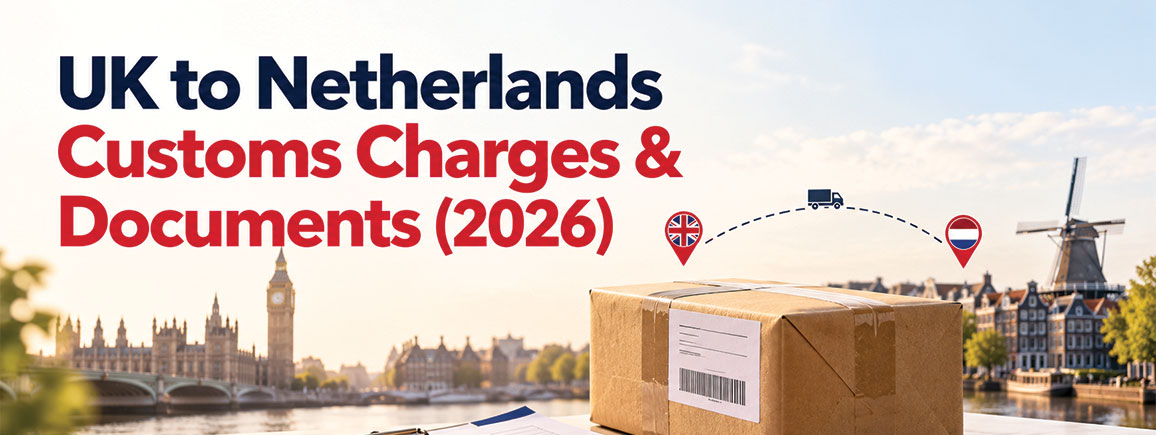
UK to Netherlands Customs Charges, VAT and Documents (2026 Guide)
Parcels containing goods sent from Great Britain to the Netherlands normally require customs clearance because the Netherlands is in the European Union. Depending on the parcel type, value, origin and contents, UK to Netherlands customs charges may include Dutch import VAT, customs duty, excise duty and carrier handling fees. Accurate descriptions, values, commodity codes and supporting documents help prevent avoidable delays and unexpected costs for both senders and recipients.
This guide primarily covers shipments from England, Scotland and Wales. Different procedures may apply to goods moving from Northern Ireland.
Do Parcels from the UK to the Netherlands Need Customs Clearance?
Since the end of the Brexit transition period, Great Britain is no longer part of the EU customs territory. As a result, parcels containing goods sent from Great Britain to the Netherlands are treated as imports into the EU and normally require customs clearance. For delivery options, rates and collection information, see our UK to Netherlands courier service.
This applies to both personal and commercial goods. Documents-only shipments may follow different procedures, but any parcel containing physical goods—clothing, electronics, gifts, samples or otherwise—generally requires a customs declaration.
Businesses exporting from Great Britain generally require a GB EORI number, commodity classification and appropriate export documentation. Personal-use goods that are not controlled may not require an EORI number, but accurate information is still needed for the customs declaration.
Northern Ireland has a different relationship with the EU’s customs rules. Shipments originating from Northern Ireland may follow separate procedures and should be assessed individually.
What Customs Charges Can Apply?
Several charges may apply when sending a parcel from the UK to the Netherlands. The table below gives an overview.
| Charge | When it may apply |
| Import VAT | Most goods imported into the Netherlands |
| Customs duty | Depends on the goods, origin, value and applicable tariff |
| Excise duty | Alcohol, tobacco and certain excise products |
| Clearance / handling fee | May be charged by the courier or customs representative |
| Storage or inspection fee | If the shipment requires additional handling |
Netherlands Import VAT
The Netherlands currently applies VAT rates of 21%, 9% and 0%, depending on the goods or services. The standard Dutch VAT rate of 21% applies to most imported goods. Certain eligible categories—such as some food products, medicines and books—may qualify for the reduced 9% rate, and 0% may apply in specific circumstances.
The applicable rate depends on the product classification. Import VAT is a separate charge from any courier handling fee and is generally calculated on the customs value of the goods.
Customs Duty and Product Classification
Customs duty on goods entering the Netherlands depends on the commodity or HS (Harmonised System) code assigned to each item. Different products attract different duty rates under the EU’s Common Customs Tariff.
Country of origin matters—not only the country from which the parcel is dispatched. Goods purchased from or stored in the UK do not automatically qualify as UK-origin goods. Some goods that genuinely originate in the UK may be eligible for preferential duty rates under the UK–EU Trade and Cooperation Agreement, but this requires the applicable rules of origin to be satisfied and proof of origin to be provided. Not all UK exports will meet these requirements.
Important: Do not assume all UK goods automatically attract zero customs duty. Preferential treatment depends on the goods meeting the relevant rules of origin and proof requirements.
2026 Customs Duty Change for Low-Value E-commerce Goods
From 1 July 2026, the previous customs-duty exemption for qualifying B2C distance-sale consignments with an intrinsic value of €150 or less was removed. A temporary €3 duty applies per declared item; under current declaration systems, it may be applied per declaration line. This temporary measure is scheduled to run until 1 July 2028.
Courier Handling and Clearance Fees
Carrier or courier fees are separate from government-imposed taxes such as import VAT and customs duty. They can include charges for customs processing, tax advancement (where the courier pays duties on the recipient’s behalf and reclaims the amount at delivery) and storage.
Whether customs charges are prepaid by the sender or collected from the recipient at delivery depends on the agreed shipping terms and the specific carrier. UDS provides a tailored quotation—check the written quote for the exact terms before dispatching.
Are Gifts Sent to the Netherlands Subject to Customs Charges?
A qualifying gift relief may apply when a parcel is sent from one private individual to another. To qualify as a gift for customs purposes, the shipment must be:
- Sent from a private person to a private person—not from a business
- Occasional in nature—not a regular or commercial transaction
- For the personal use of the recipient
- Not paid for by the recipient and not intended for resale
Qualifying gifts with a total value of up to €45 may be exempt from import duty and VAT. Gifts valued above €45 can attract Dutch import VAT, customs duty and possibly excise duty, depending on the contents.
Do not describe a commercial sale as a gift. An inaccurate customs declaration may result in reassessment, delays or enforcement action.
Documents Required for UK to Netherlands Shipping
Accurate and complete documentation is one of the most important factors in avoiding delays at Netherlands customs. The following documents are typically required.
Customs Declaration
A customs declaration is generally required for parcels containing goods.
- Reason for export (sale, gift, personal effects, return, etc.)
- Detailed description of each item
- Quantity and weight
- Individual and total declared values
- Country of origin for each item
- Commodity or HS code for each item
Commercial or Pro Forma Invoice
A commercial invoice is required for sold goods and commercial shipments. It should clearly state the buyer and seller details, item descriptions, quantities, unit values and total value, and country of origin.
Pro forma documentation may be appropriate for suitable non-commercial shipments, subject to the carrier’s requirements. Avoid vague descriptions such as “items,” “samples” or “personal goods.” Use specific descriptions instead—for example, “two cotton shirts” or “printed business documents.”
Packing List
A packing list is especially relevant for:
- Shipments in multiple boxes
- Commercial consignments with several line items
- Mixed-item shipments
- Excess baggage or personal effects
Proof of Origin
Proof of origin may be required to support a claim for preferential tariff treatment under the UK–EU Trade and Cooperation Agreement. Being “shipped from the UK” does not automatically prove that the goods originate in the UK. The requirements depend on the product and the applicable rules of origin.
EORI Number
An EORI (Economic Operators Registration and Identification) number is usually required for businesses exporting from Great Britain. Personal-use shipments may not require one if the goods are not controlled. Controlled goods—such as certain chemicals, medicines or dual-use items—can have additional registration and licensing requirements.
Licences or Certificates
Some goods require a licence, permit or certificate before they can be legally exported or imported. Examples include:
- Food and animal products
- Plants and seeds
- Medicines and medical devices
- Chemicals and hazardous substances
- Alcohol and tobacco
- Batteries and dangerous goods (subject to transport regulations)
Requirements vary. Check the relevant regulations before sending, and do not assume acceptance.
Businesses that need assistance with documentation can review our customs clearance services.
How Are Netherlands Customs Charges Calculated?
Customs duty and import VAT calculations can depend on several factors:
- Declared value of the goods
- Shipping and insurance costs to the EU border
- Commodity or HS code
- Country of origin
- Applicable duty rate under the EU Common Customs Tariff
- Applicable VAT rate
- Any excise or handling charges
Dutch Customs generally calculates customs value using the goods’ transaction value plus transport, insurance and related costs up to the external EU border. The import VAT base can include the customs value, applicable customs duty and certain additional costs. The exact calculation depends on the goods and circumstances.
Exact figures depend on the specific goods and circumstances. Any figures used in your own planning should be treated as estimates until confirmed by the relevant authority or your customs representative.
Who Pays the Customs Charges?
Responsibility for customs charges depends on the agreed shipping terms—commonly expressed as Incoterms:
- DAP (Delivered at Place): The recipient or importer normally handles import clearance and pays the applicable duties, VAT and clearance charges..
- DDP (Delivered Duty Paid): The sender is responsible for arranging import clearance and paying the agreed import charges.
Charges should be confirmed and agreed before dispatching the parcel. Review the UDS written quotation carefully to understand exactly which charges are included and which may be collected separately.
Prohibited and Restricted Items
Certain items cannot be sent to the Netherlands under any circumstances, and others are subject to restrictions or require permits. Examples include:
- Explosives and weapons
- Illegal drugs and controlled substances
- Flammable or hazardous materials (subject to transport regulations)
- Loose or damaged batteries
- Certain medicines
- Perishable food items
- Alcohol and tobacco (subject to excise rules and quantity limits)
- Plants, seeds and animal products (subject to phytosanitary rules and the Convention on International Trade in Endangered Species (CITES).
Check the UDS Prohibited and Restricted Goods Policy before packing your parcel.
Common Reasons Parcels Are Delayed at Netherlands Customs
Many customs delays are linked to incomplete, inaccurate or inconsistent shipment information.
- Vague or missing product descriptions on the declaration
- Missing or incorrect commercial invoice
- Undervalued or misvalued goods
- Wrong or missing commodity code
- Missing country of origin
- Incomplete sender or receiver contact details
- Restricted goods sent without prior approval or permits
- Duties or VAT not paid when required
- Discrepancies between the declared invoice and the actual parcel contents
How to Prepare Your Parcel for Customs Clearance
Follow these steps before handing your parcel over for dispatch:
- Confirm that every item in your parcel is accepted for export from the UK and import into the Netherlands.
- Record an accurate description and quantity for each item.
- Declare the correct market or sale value—do not undervalue.
- Identify the correct commodity or HS code for each item.
- Confirm the country of origin for each item.
- Prepare the required commercial invoice or pro forma documentation and packing list.
- Include complete sender and recipient contact details, including telephone numbers.
- Pack all items securely to reduce the risk of damage or inspection delay.
- Confirm with your carrier who is responsible for paying duties and taxes.
- Keep copies of all shipping documents for your records.
Sending a Parcel from the UK to the Netherlands with UDS
UDS offers door-to-door collection and delivery for parcels and commercial shipments from the UK to the Netherlands, with both express and standard service options to suit different budgets and timelines.
Live tracking is available for supported UDS services, allowing customers to follow their parcels during transit. UDS also provides customs-documentation support to help ensure your paperwork is in order before dispatch, reducing the risk of avoidable delays.
Whether you are sending personal items or business goods, UDS handles both individual parcels and larger consignments. Quotations are based on the parcel’s weight, dimensions, declared contents and collection and delivery postcodes.
Need help arranging a UK to Netherlands parcel? Share the parcel contents, value, weight, dimensions and collection and delivery postcodes with UDS to receive a tailored quotation.
Frequently Asked Questions
Do I have to pay customs when sending a parcel from the UK to the Netherlands?
It depends on the contents, value, country of origin, shipment type and any applicable exemptions. Most parcels containing goods require customs clearance and may attract Dutch import VAT, customs duty or both. Qualifying private gifts valued up to €45 may be exempt. A customs declaration is generally required regardless.
What is the import VAT rate in the Netherlands?
The standard Dutch import VAT rate is 21%. Certain eligible goods—such as some food products and medicines—may qualify for the reduced rate of 9%. A 0% rate can apply in specific circumstances. The applicable rate depends on the product classification.
Are gifts sent from the UK to the Netherlands tax-free?
Qualifying private gifts sent between individuals (not businesses) with a total value of up to €45 may be exempt from import duty and VAT. Gifts over €45 can attract Dutch import VAT and possibly customs duty. The gift must be genuine, occasional and for the personal use of the recipient—commercial transactions must not be declared as gifts.
What documents are needed to send a parcel to the Netherlands?
Typically: a customs declaration (with item descriptions, quantities, values, country of origin and HS codes), a commercial invoice or pro forma documentation, and a packing list for multi-item or commercial shipments. Proof of origin may be needed for preferential duty claims. Licences or certificates may be required for certain goods, such as food, plants or medicines.
Does the UK–EU trade agreement mean there is no customs duty?
No. The UK–EU Trade and Cooperation Agreement allows some UK-origin goods to qualify for preferential (including zero) duty rates, but this is not automatic. The goods must meet the relevant rules of origin, and proof of origin must be provided. Goods that do not satisfy the rules of origin are subject to standard EU duty rates.
Who pays customs charges in the Netherlands?
Responsibility is usually determined by the agreed shipping terms. Under DAP (Delivered at Place), the receiver generally pays import charges before the parcel is released. Under DDP (Delivered Duty Paid), the sender arranges payment. Always confirm the terms in writing before dispatch.
How long does Netherlands customs clearance take?
There is no guaranteed timeframe. Straightforward shipments with accurate paperwork can clear quickly, while incomplete or incorrect documents may cause delays of several days or longer. Providing accurate information, correct values and all required documents—and paying any duties promptly—helps reduce avoidable delays.
